
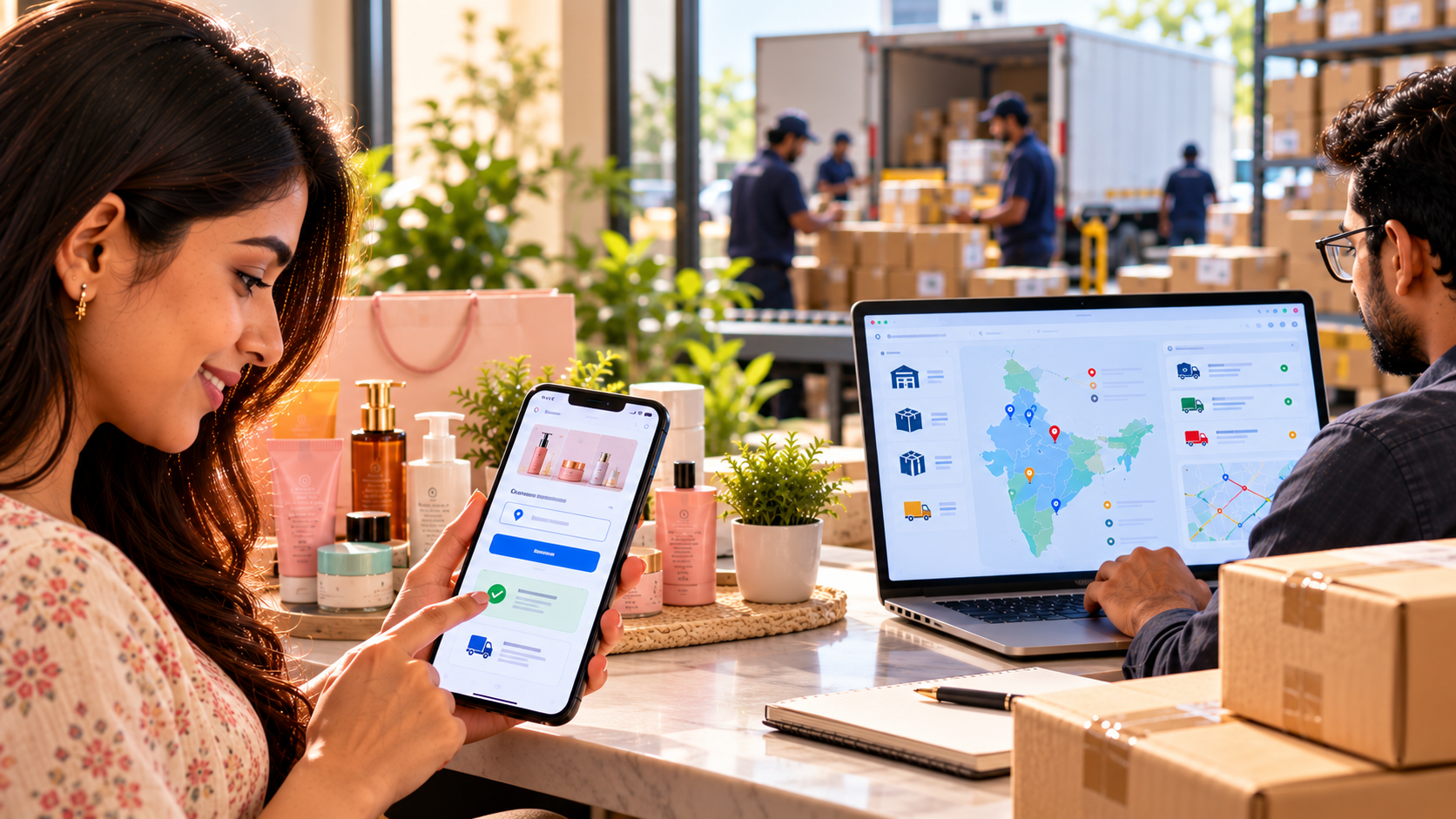
When shopping online, customers often want to know one thing before placing an order:
“Can this product be delivered to my PIN code?”
This simple question is connected to a much larger system operating behind an e-commerce website.
A customer enters a PIN code, but the platform may need to evaluate delivery coverage, fulfilment locations, logistics availability, product information, and other shipping rules before determining whether an order can be supported.
This process is commonly known as PIN code serviceability.
For an e-commerce platform such as MYKSHI, understanding how PIN code serviceability works is important because delivery availability can directly affect the customer’s shopping journey.
What Is PIN Code Serviceability?
PIN code serviceability is the process of checking whether an e-commerce order can be delivered to a particular destination identified by its PIN code.
In India, PIN codes help identify geographic delivery areas.
When a customer enters a PIN code on an e-commerce platform, the system can use it as a location reference and compare it against available delivery information.
A simplified process looks like this:
Customer Enters PIN Code
↓
System Identifies Destination
↓
Delivery Coverage Is Checked
↓
Relevant Shipping Information Is Evaluated
↓
Customer Receives a Serviceability Result
The exact process differs between e-commerce businesses and their logistics systems.
Why PIN Code Serviceability Matters
Delivery is one of the most important parts of online shopping.
A customer may find a product they want, but the purchase can only be completed successfully if the order can reach the destination.
Checking PIN code serviceability early can help customers understand delivery availability before investing too much time in the checkout process.
It can potentially reduce uncertainty around:
- Delivery availability
- Shipping options
- Checkout
- Order fulfilment
This makes serviceability an important part of the overall customer experience.
How a PIN Code Check Works
The process may appear simple to the customer.
They enter a PIN code and receive a result.
Behind that interaction, an e-commerce platform can potentially perform several checks.
A typical workflow may include:
- The customer enters a PIN code.
- The system validates the entered information.
- The destination is identified.
- Delivery coverage is checked.
- Relevant fulfilment and shipping information is evaluated.
- The platform displays the applicable result.
The specific checks depend on the platform’s technology and logistics integrations.
PIN Code Is a Location Reference
A PIN code is useful because it provides a standardised way to represent a destination area.
For e-commerce businesses operating across India, customers can enter their local PIN code rather than manually describing their location.
This simplifies the initial delivery check.
However, a PIN code should not necessarily be treated as a complete representation of every delivery condition.
Other factors can influence whether a particular order can be fulfilled.
PIN Code vs. Exact Address
There is an important difference between a PIN code and a complete delivery address.
A PIN code generally represents a geographic delivery area, while an address identifies a more specific destination.
A serviceability check may initially use the PIN code to determine broad delivery coverage.
Additional address information may be required later in the checkout or fulfilment process.
This means:
PIN Code Check ≠ Complete Delivery Confirmation
It is one part of the delivery workflow.
What Happens After a PIN Code Is Entered?
Once a customer enters a PIN code, the e-commerce system may compare it with its available delivery information.
For example, the system may determine whether the destination is within the supported network of a relevant shipping or logistics service.
The result could indicate that the location is supported, unsupported, or subject to additional conditions.
The customer can then continue with the appropriate next step.
The Role of Logistics Partners
E-commerce businesses frequently depend on logistics networks to move products from fulfilment locations to customers.
A logistics network may have different areas of coverage.
Some destinations may have standard delivery support, while others may have limited or unavailable services.
A PIN code serviceability system can potentially use logistics information to determine whether the destination is supported.
The exact logistics providers and integrations used by MYKSHI depend on its current operational setup.
Product Availability Can Affect Serviceability
Delivery is not only about the customer’s location.
The product itself can also matter.
An item may be available in one fulfilment location but unavailable in another.
If the available inventory is not positioned within a suitable delivery network, the platform may face fulfilment limitations.
This creates an important relationship:
Product → Inventory Location → Logistics Network → Customer PIN Code
Technology helps connect these pieces.
Why Inventory Location Matters
Consider a simple example.
A product is stored at a fulfilment location that serves a particular group of destinations.
A customer enters a PIN code outside that network.
The product may exist in inventory, but that does not automatically mean it can be delivered to that destination through the available shipping arrangement.
This is why serviceability can depend on more than stock quantity.
It can also involve where the stock is located.
Serviceability and Shipping Rules
E-commerce platforms may have specific shipping rules.
These can potentially involve:
- Delivery coverage
- Shipping methods
- Product restrictions
- Fulfilment arrangements
- Order characteristics
- Logistics availability
A serviceability system can apply the relevant rules before allowing the customer to proceed.
This helps create a more predictable checkout experience.
Serviceability and Cash on Delivery
Cash on Delivery, commonly called COD, can have different availability from standard prepaid ordering.
Depending on the logistics network and business rules, COD may not be supported for every destination.
This means an e-commerce system may need to evaluate both:
Can the order be delivered?
and
Which payment options are available for that destination?
The answers can depend on the specific order and applicable rules.
Can PIN Code Serviceability Change?
Yes.
Delivery coverage is not necessarily permanent.
Logistics networks can change because of operational decisions, service expansion, temporary restrictions, or other circumstances.
A previously supported destination may experience temporary limitations.
Likewise, a previously unsupported area may become serviceable in the future.
This is why serviceability information may need regular updates.
Real-Time Serviceability Checks
Modern e-commerce systems can potentially perform serviceability checks dynamically.
Instead of relying only on static information, the platform can communicate with relevant systems to obtain current information where supported.
This can be especially useful when information changes frequently.
However, real-time functionality depends on the technical architecture, data sources, integrations, and operational processes of the e-commerce business.
What Does “Not Serviceable” Mean?
If a PIN code is marked as not serviceable, it generally means the current delivery setup does not support that destination for the relevant order.
It does not necessarily mean that delivery can never happen there.
The limitation could depend on:
- Current logistics coverage
- Product fulfilment location
- Shipping restrictions
- Temporary operational conditions
- Applicable delivery rules
Customers should therefore treat the displayed result as information about the current delivery setup.
How Serviceability Can Reduce Checkout Problems
One advantage of checking serviceability early is that it can potentially identify delivery limitations before checkout is completed.
Without an early check, a customer could spend time selecting products and entering information only to discover a delivery problem later.
A serviceability check can move that information earlier in the journey.
The customer can then make a more informed decision.
PIN Code Serviceability and Customer Experience
A technical delivery check may seem like a backend function, but it can directly affect how customers experience an e-commerce platform.
A clear serviceability experience can help customers understand:
- Whether delivery is supported
- What to expect before checkout
- Whether they can continue shopping
- Whether another delivery option may be available
The objective is not to expose complicated logistics information.
It is to give customers useful information at the right moment.
How MYKSHI Can Use PIN Code Serviceability

For MYKSHI, PIN code serviceability can form part of the connection between the product catalogue and the delivery process.
A simplified customer journey could look like:
Customer Finds Product
↓
Enters PIN Code
↓
MYKSHI Checks Applicable Serviceability Information
↓
Delivery Availability Is Displayed
↓
Customer Continues Shopping or Checkout
This can make delivery information more visible during the purchasing journey.
PIN Code Serviceability and MYKSHI’s Delivery Network
As MYKSHI’s e-commerce operations develop, delivery serviceability can become increasingly important.
The platform may need to coordinate information across:
- Product catalogue
- Inventory
- Order management
- Shipping
- Logistics
- Customer support
A connected technology environment can make it easier to apply consistent serviceability rules.
The exact systems and integrations used by MYKSHI depend on its implementation.
Serviceability Becomes More Complex as E-Commerce Grows
A small online store may have a relatively simple delivery network.
As the business grows, the number of products, customers, destinations, and logistics requirements can increase.
A larger e-commerce operation may need to handle:
More Products
More Locations
More Orders
More Logistics Data
That makes automation increasingly valuable.
Technology can perform repetitive checks consistently across many customer interactions.
PIN Code Serviceability in a Future Marketplace
MYKSHI’s longer-term marketplace direction could introduce additional serviceability considerations.
A marketplace may include products from multiple sellers.
Different sellers could potentially operate from different fulfilment locations and use different shipping arrangements.
A future marketplace serviceability workflow may therefore need to consider:
- Customer PIN code
- Seller location
- Product availability
- Fulfilment location
- Shipping coverage
- Logistics partner
- Delivery rules
This creates a more complex serviceability environment than a single-store model.
Why Accurate Data Matters
PIN code serviceability depends heavily on data quality.
If the system has outdated delivery coverage information, it may provide an incorrect result.
Incorrect serviceability can create two types of problems.
Incorrectly Marked as Serviceable
The customer may place an order that cannot be fulfilled through the available network.
Incorrectly Marked as Not Serviceable
A potentially deliverable order may be prevented from moving forward.
Both situations can negatively affect the customer experience.
Serviceability and Customer Support
Automation can handle routine serviceability checks, but customer support still has an important role.
Customers may sometimes ask why a location is unavailable or encounter circumstances that are not covered by the standard workflow.
Human support can investigate such cases where appropriate.
This creates a balanced approach:
Technology handles routine checks.
Human support handles exceptions.
Technology Behind the Simple Experience
From the customer’s perspective, PIN code serviceability can be as simple as entering six digits.
But behind that simple interaction may be several connected systems.
The platform may need to coordinate:
Customer Data
→ Location Information
→ Product Data
→ Inventory
→ Shipping Rules
→ Logistics Coverage
→ Serviceability Result
This is an example of how modern e-commerce technology hides operational complexity behind a simple user interface.
Building a Better Delivery Experience
The purpose of PIN code serviceability is not merely to produce a technical “yes” or “no.”
It can help create a better shopping experience.
Customers want clarity.
Businesses want predictable fulfilment.
Logistics teams need accurate information.
Technology connects these requirements.
When serviceability information is reliable and presented clearly, each part of the e-commerce journey can work more smoothly.
The Future of PIN Code Serviceability
As e-commerce continues to expand across India, delivery networks will also become more sophisticated.
Technology can potentially make serviceability checks faster, more accurate, and more closely connected with inventory and fulfilment systems.
For platforms like MYKSHI, this can become increasingly important as the product catalogue grows and the business works toward a broader marketplace model.
The future may involve more intelligent connections between:
Customer Location + Product + Inventory + Seller + Logistics + Delivery
The result can be a more coordinated shopping experience.
Final Thoughts
PIN code serviceability may look like a small feature on an e-commerce website, but it represents an important connection between customers and logistics.
When a customer enters a PIN code, the platform may need to consider delivery coverage, product availability, fulfilment, logistics information, and applicable shipping rules.
For MYKSHI, technology can help bring these different elements together and provide customers with clearer delivery information during their shopping journey.
As MYKSHI continues developing its e-commerce platform and explores a future marketplace, serviceability can become an important part of making the system scalable and customer focused.
The idea is simple:
Before customers place an order, help them understand whether the product can reach them.
That small step can make the larger e-commerce experience more transparent, predictable, and convenient.
Frequently Asked Questions
What is PIN code serviceability?
PIN code serviceability is the process of checking whether an e-commerce order can be delivered to a destination associated with a particular PIN code.
How does PIN code serviceability work in e-commerce?
A customer enters a PIN code, and the platform can compare the destination with available delivery coverage, fulfilment information, logistics arrangements, and other applicable shipping rules.
Why is PIN code serviceability important?
It helps customers understand delivery availability before completing their purchase and can potentially reduce avoidable fulfilment problems.
Is a PIN code the same as a complete delivery address?
No. A PIN code generally identifies a geographic delivery area, while a complete address identifies the specific delivery destination.
Can every product be delivered to every PIN code?
Not necessarily. Delivery availability can depend on the product, inventory location, fulfilment arrangements, logistics coverage, and other applicable rules.
Can PIN code serviceability change?
Yes. Delivery networks and operational conditions can change, so serviceability information may need to be updated regularly.
Does PIN code serviceability guarantee delivery?
No. A serviceability result indicates that delivery is supported under the applicable conditions. Actual delivery can still be affected by later logistical or operational circumstances.
Can PIN code serviceability affect Cash on Delivery?
Potentially. COD availability may depend on the destination and applicable logistics or business rules.
Leave a Reply