
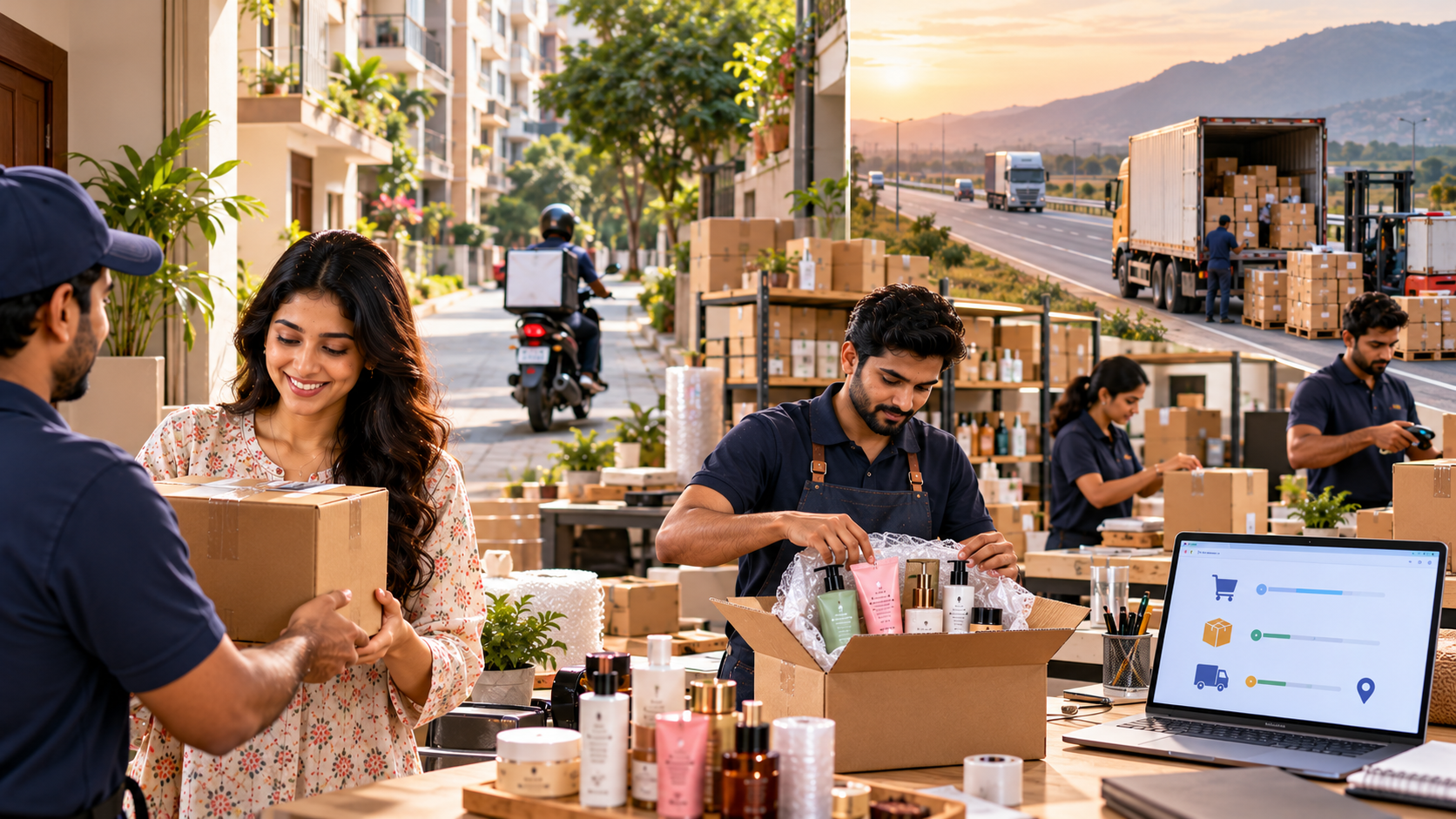
When customers place an online order, they usually think about the product first.
They find what they need, compare their options, complete checkout, and wait for the package to arrive.
But behind every successful delivery is a process that connects the customer’s location, the order information, the product, fulfilment, packaging, and logistics.
For an e-commerce platform like MYKSHI, delivery is therefore more than simply moving a parcel from one place to another.
It is an important part of the overall customer experience.
Whether an order is travelling to a nearby location or across a longer distance, the objective is to create a structured process that allows the order to move from checkout toward delivery as smoothly as possible.
Why Delivery Matters in E-Commerce

The shopping experience does not end when a customer clicks “Place Order.”
In many ways, that is when another part of the customer journey begins.
Customers naturally want to know:
- Has the order been processed?
- Is the product being prepared?
- Has the package been dispatched?
- Where is the order?
- When can it be expected?
This makes delivery closely connected to customer satisfaction.
A well-organised delivery process can reduce uncertainty and help customers understand what is happening after they complete their purchase.
Local Delivery and Long-Distance Delivery Are Different
Not every order travels the same distance.
A customer located relatively close to the fulfilment point may have a shorter logistics journey.
Another customer may be located much farther away and require additional transportation stages.
This creates a basic difference between local delivery and long-distance delivery.
Local deliveries may involve fewer geographical stages.
Long-distance deliveries can involve additional movement between locations and logistics facilities.
The exact process depends on the logistics network, destination, order characteristics, and other operational factors.
For MYKSHI, the important consideration is building a delivery process that can handle these differences.
What Happens After Checkout?
The delivery journey begins with accurate order information.
Once a customer completes checkout, the order needs to contain the relevant details required for fulfilment and delivery.
This can include:
- Customer information
- Delivery address
- Products ordered
- Quantity
- Order status
- Payment status
- Relevant fulfilment information
Accurate information is essential because delivery depends on the details associated with the order.
An incorrect or incomplete address, for example, can create complications later in the journey.
Product Availability Comes First
Before an order can move toward delivery, the required products need to be available for fulfilment.
This makes inventory management an important part of delivery operations.
If a product is unavailable, the order may require additional attention before it can progress.
Maintaining structured product and inventory information helps an e-commerce platform understand what can be fulfilled.
As MYKSHI’s product catalogue grows, inventory visibility becomes increasingly important to the wider order and delivery process.
Preparing the Order for Dispatch
Once the order is ready to move forward, the required products need to be picked and prepared.
The goal is straightforward:
The customer should receive the products associated with their order.
This requires attention to product identity, quantity, variants, and packaging.
For beauty and personal care products, appropriate preparation is particularly important because many products come in different formats, sizes, shades, or variants.
Careful order preparation helps reduce avoidable fulfilment errors.
Packaging for the Journey
An order may travel only a short distance or move through a much longer delivery route.
Either way, packaging is important.
The package needs to be prepared with transportation in mind.
Beauty, skincare, haircare, and personal care products can have different packaging requirements depending on their form and physical characteristics.
Good packaging should help protect the contents while also providing customers with an organised unboxing experience.
The packaging stage therefore connects fulfilment with the physical delivery journey.
How Local Delivery Can Be Different
Local orders can have a relatively straightforward transportation journey when the destination is close to the relevant fulfilment location.
There may be fewer transportation stages involved.
However, local does not automatically mean effortless.
The order still needs:
Accurate information
The delivery details must be correct.
Proper preparation
The correct products need to be packed.
Dispatch coordination
The package needs to enter the delivery process.
Customer communication
Relevant updates should be available when appropriate.
Even a short-distance order requires coordination.
Managing Longer-Distance Orders
Long-distance orders introduce additional logistical considerations.
A package may need to travel through multiple locations before reaching its final destination.
This can create more opportunities for delays or changes during transportation.
For that reason, visibility becomes especially useful.
Customers benefit from being able to understand the status of their order as it moves through the delivery journey.
The longer the journey, the more important clear communication can become.
Tracking Helps Connect the Customer to the Delivery
After an order leaves the fulfilment stage, customers may not be able to see what is happening physically.
This is where tracking information can help.
Tracking can provide visibility into the order’s progress when such information is available through the relevant delivery process.
Instead of wondering where the package is, the customer can use the available status information to understand its progress.
This is an important part of the modern e-commerce experience.
Delivery Communication Builds Confidence
Delivery is not only a logistics function.
It is also a communication process.
Customers have already made a purchasing decision and are waiting for the physical result.
Appropriate order updates can help them feel informed.
This becomes especially useful when the order involves a longer journey.
Clear communication helps reduce unnecessary uncertainty and gives customers a better understanding of the order’s current stage.
What Happens When a Delivery Has an Issue?
Even well-designed logistics processes can encounter unexpected situations.
A delivery may take longer than expected.
An address may require clarification.
A delivery attempt may not be successful.
A package may encounter a transportation issue.
These situations highlight why customer support is connected to delivery.
The objective should be to identify the issue, understand the available information, and guide the customer toward the appropriate next step.
Customer Support Is Part of Delivery
Customers may contact support for many delivery-related reasons.
They might ask about order status.
They may need help understanding tracking information.
They could have a question about their delivery details.
They may report an issue after an attempted delivery.
A useful support process can help customers navigate these situations.
This means delivery should not be viewed as a completely separate function from customer service.
They are connected parts of the same customer journey.
Technology Helps Coordinate Delivery
Modern e-commerce relies on technology to connect different stages of an order.
The platform needs to manage information from checkout through fulfilment and delivery.
Technology can help connect:
Customer → Order → Product → Fulfilment → Dispatch → Delivery
As the number of orders increases, this connectivity becomes increasingly important.
A strong digital infrastructure can make it easier to manage growing operational complexity.
Automation Can Improve Repetitive Delivery Work
Some parts of order management involve repetitive activities.
For example, systems can potentially automate certain:
- Order notifications
- Status updates
- Internal alerts
- Delivery-related communications
- Customer-support workflows
- Administrative processes
Automation can help reduce unnecessary manual work.
However, it should be designed carefully.
The purpose should be to make the process more efficient without reducing clarity or customer support quality.
AI and Delivery Support
AI can potentially support certain parts of the delivery experience.
For example, an AI-assisted customer-support system could help customers find answers to common questions about order status or delivery information.
It could also help direct more complex issues toward the appropriate support process.
But AI should work with accurate underlying information.
An automated answer is useful only when the information behind it is reliable.
Local and Long-Distance Delivery Need the Same Foundation
Although local and long-distance orders may follow different logistical paths, both depend on the same fundamentals.
Accurate order data.
Product availability.
Correct fulfilment.
Appropriate packaging.
Dispatch coordination.
Delivery visibility.
Customer communication.
These fundamentals create the foundation for a reliable delivery experience.
Scaling Delivery as MYKSHI Grows
As an e-commerce platform grows, delivery operations naturally become more complex.
More products can mean more fulfilment requirements.
More customers can mean more delivery destinations.
More orders can mean more operational data.
A future marketplace can introduce another layer by involving multiple sellers.
This makes scalability important.
MYKSHI needs to think not only about how delivery works today, but also about how the underlying systems can support greater complexity in the future.
The Future Marketplace Could Change Delivery Operations
A marketplace differs from a traditional online store because products may eventually come from multiple sellers.
This could mean that delivery processes need to account for seller locations, seller fulfilment practices, inventory availability, and different order flows.
The platform would need to create appropriate systems that connect sellers and customers while keeping the customer experience understandable.
This is one reason marketplace development requires more than simply adding seller accounts to a website.
More Distance Does Not Have to Mean More Confusion
Long-distance delivery can naturally involve more logistical stages.
But the customer’s experience does not need to become complicated.
A well-designed e-commerce platform should aim to make the customer journey simple:
Order → Processing → Dispatch → Tracking → Delivery
The complexity can remain behind the scenes.
Customers should have access to the information they need without having to understand the entire logistics network.
Delivery Is Part of the MYKSHI Brand Experience
A customer may discover MYKSHI through a search result, social-media post, blog article, or product page.
They may then place an order.
The delivery experience becomes one of the final stages of that journey.
If the product arrives appropriately and the order experience is clear, delivery becomes a natural continuation of the customer’s online experience.
This is why logistics should not be treated as something completely separate from the brand.
It is part of how customers experience the business.
Learning From Every Delivery
Every order can provide useful information.
If customers repeatedly ask about delivery status, communication may need improvement.
If certain destinations create recurring problems, operational processes may need review.
If particular products require additional packaging attention, fulfilment procedures can be improved.
This creates a valuable feedback loop:
Delivery Experience → Data → Learning → Process Improvement
For a growing e-commerce platform, this continuous learning can help strengthen operations over time.
Building for a Larger Future
MYKSHI’s longer-term marketplace vision makes delivery an increasingly important area to consider.
A broader marketplace could involve:
- More sellers
- More products
- More destinations
- More orders
- More fulfilment scenarios
The technology and operational processes therefore need to evolve alongside the business.
The goal is not simply to deliver more packages.
It is to build a system capable of supporting a larger digital commerce ecosystem.
Final Thoughts
How MYKSHI handles local and long-distance delivery is ultimately about creating a structured journey from online checkout to physical delivery.
A local order and a long-distance order may travel through different logistical paths, but both depend on accurate information, product availability, careful fulfilment, appropriate packaging, delivery coordination, and useful customer communication.
As MYKSHI continues to develop, these processes can become increasingly important.
The platform’s future growth may bring more products, more customers, and potentially more sellers.
That means delivery systems need to grow alongside the wider business.
The most important principle is simple:
Customers should experience a clear and straightforward delivery journey, even when the logistics behind it are complex.
From the first checkout click to the arrival of the package, every stage contributes to that experience.
And for MYKSHI, building that experience is part of the larger journey toward becoming a scalable digital commerce platform.
Frequently Asked Questions
How does MYKSHI handle local delivery?
Local orders can follow a relatively shorter logistics journey when the delivery destination is close to the relevant fulfilment location. The order still depends on accurate information, fulfilment, packaging, dispatch, and delivery coordination.
How does MYKSHI handle long-distance delivery?
Long-distance orders may involve additional transportation stages depending on the destination and logistics network. Appropriate order visibility and communication can help customers understand the progress of their delivery.
Is local delivery always faster than long-distance delivery?
Not necessarily. Delivery time can depend on several factors, including destination, logistics arrangements, order processing, availability, and other operational circumstances.
Why is accurate delivery information important?
Accurate delivery information helps ensure that the order can be processed and directed toward the intended destination correctly.
Why is packaging important for MYKSHI orders?
Packaging helps protect products during transportation and contributes to the customer’s experience when receiving the order.
Can customers track their MYKSHI orders?
Where tracking information is available through the applicable delivery process, it can help customers understand the progress of their order.
Leave a Reply